Low voltage cabling contractors in Bergen County, NJ handle the wiring that keeps data, security, and AV systems running inside offices, warehouses, and medical suites from Paramus to Hackensack. A loose connection or an unlicensed install rarely fails on day one. It fails quietly, months later, during a camera outage or a dropped network. This guide breaks down what these contractors actually install, what New Jersey requires of them, and what changed in the electrical code in 2026 that most local company websites still haven't caught up with.
What Low Voltage Cabling Contractors in Bergen County, NJ Install
Low voltage work isn't one service. It's a category of systems that share wiring standards but solve different problems. A commercial-grade contractor should be able to handle all of the following under one scope of work, rather than subcontracting pieces out:
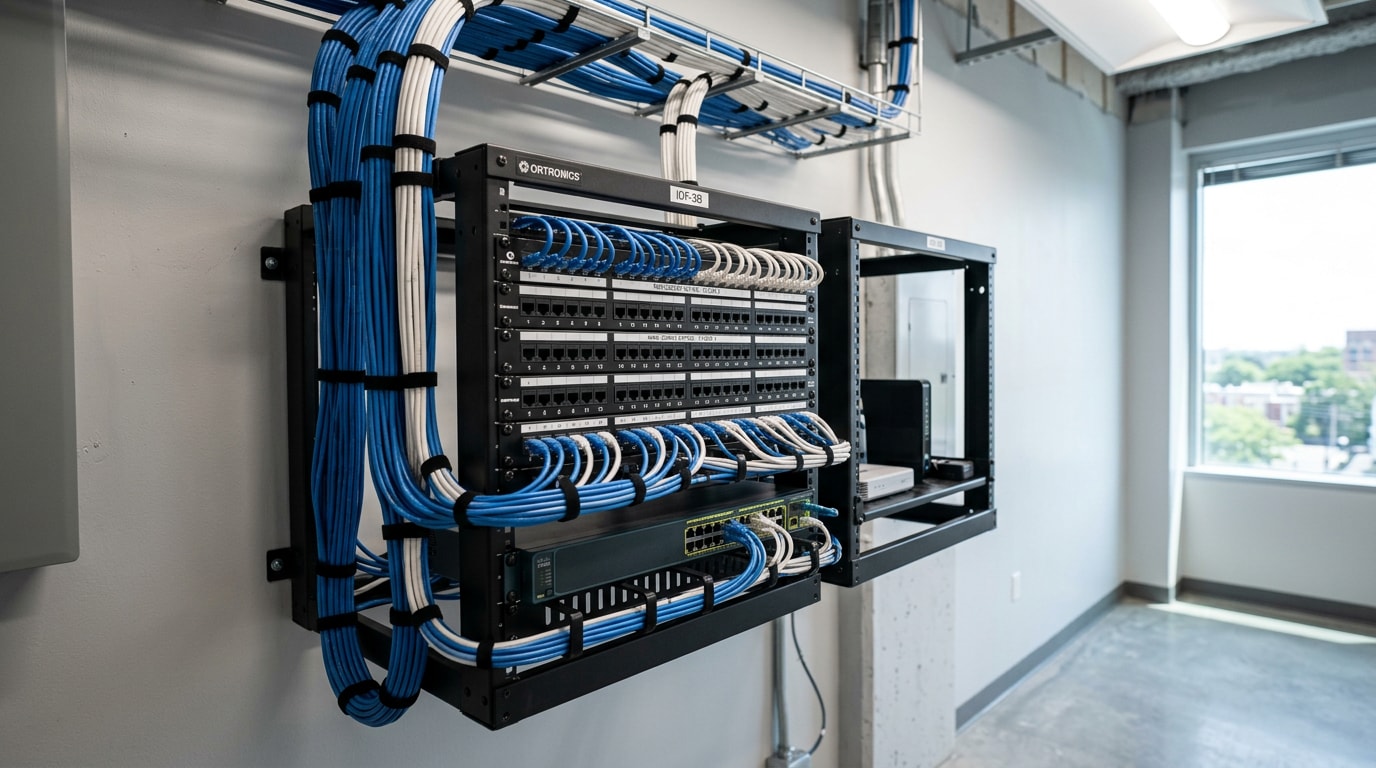
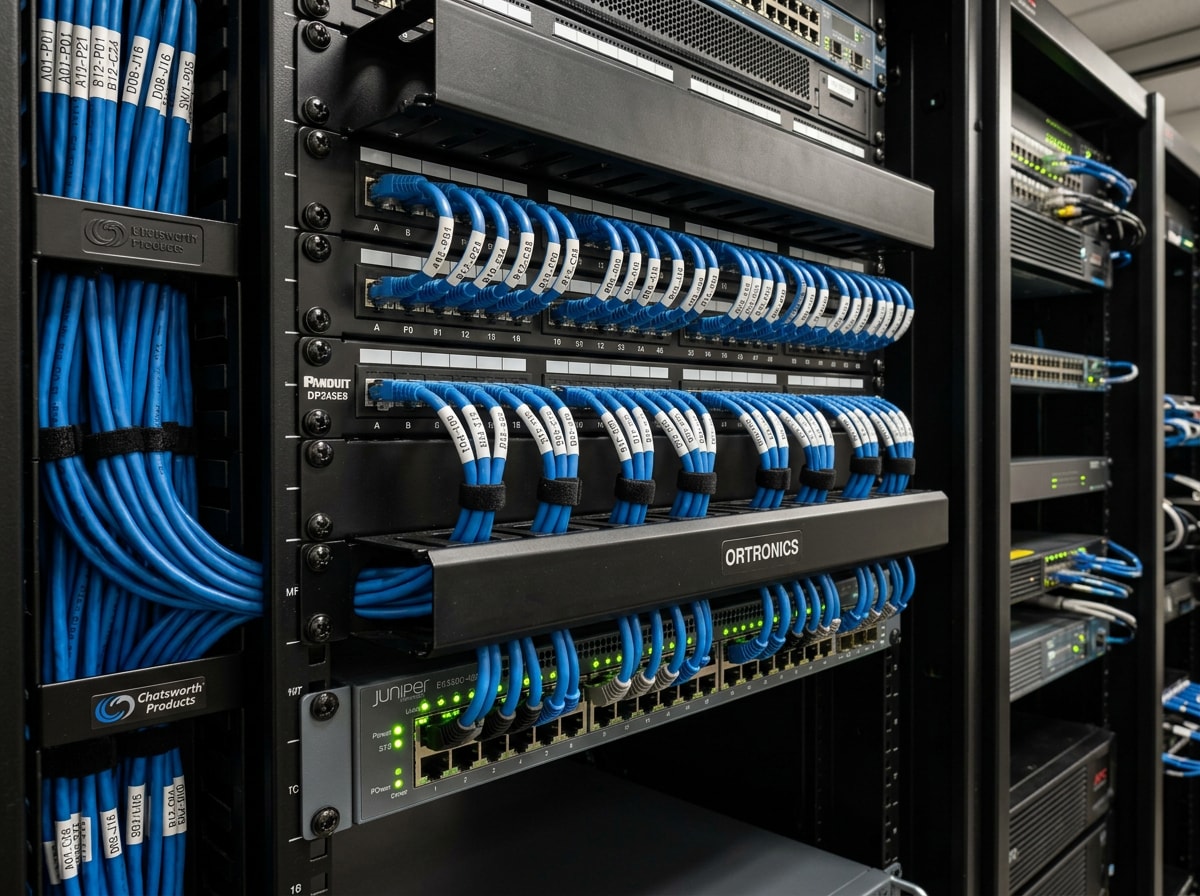
- Structured cabling and network infrastructure – the data runs behind Wi-Fi, VoIP phones, and office networking that most spotty-internet complaints actually trace back to.
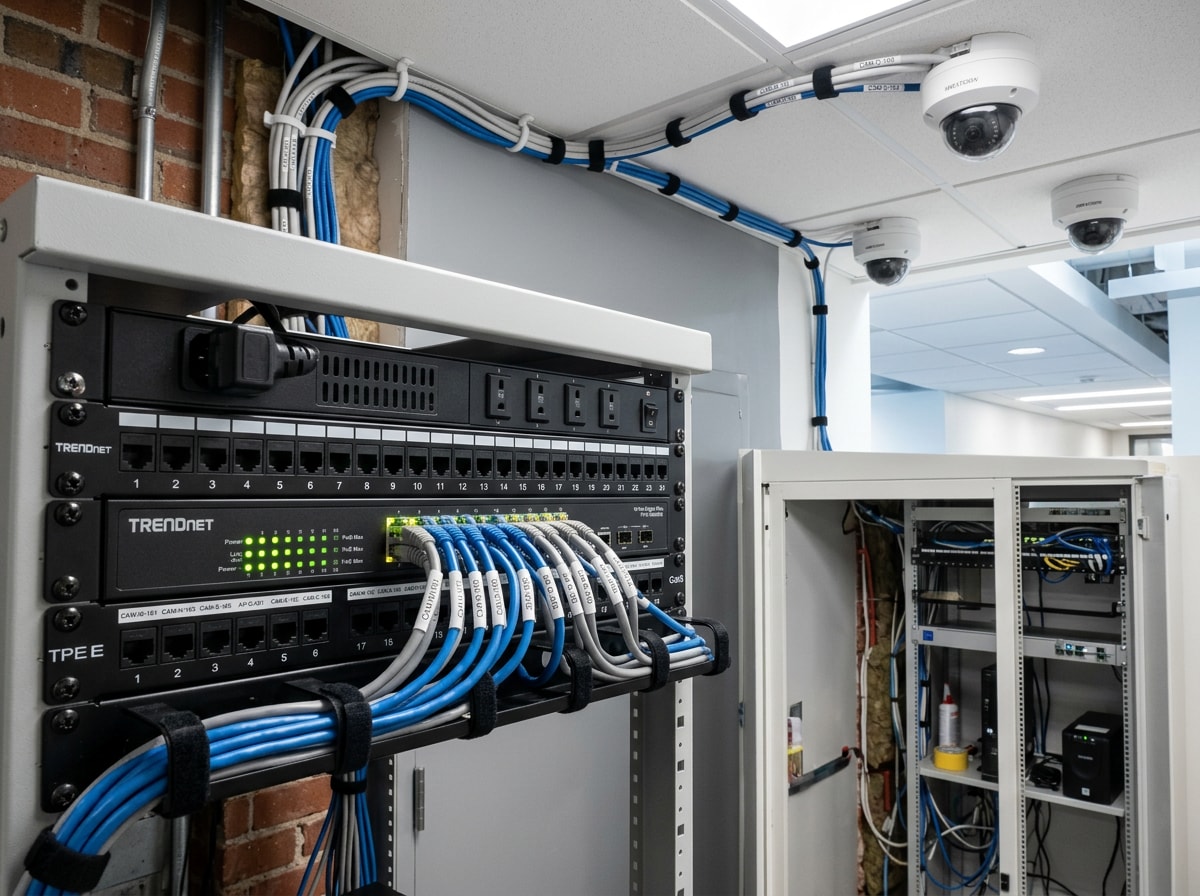
- Security cameras and CCTV – dedicated runs to each camera plus a central recording point, typically an NVR.
- Alarm and intrusion systems – wiring that connects sensors, control panels, and monitoring stations without false-trigger gaps.
- Access control and intercoms – door entry hardware paired with video or audio verification before a door unlocks remotely.
- Audio-visual systems – conference room displays, paging, and boardroom AV that need clean, low-clutter wiring to avoid dropped signals.
- Home and building automation – lighting, climate, and access control run from one low voltage backbone in smart offices and multi-unit buildings.
A contractor that only offers one or two of these is fine for a small job, but larger buildouts move faster when one team owns the whole stack. Our commercial electrical contracting team scopes these projects alongside the rest of a building's electrical work rather than treating low voltage as an afterthought.
Bergen County Service Area
Coverage for this kind of work typically spans the Bergen County business corridors in Hackensack, Paramus, Fort Lee, Ridgewood, Teaneck, and Englewood, with project sizes ranging from a single-office data run to full building cabling for new construction. See our Bergen County service area page for full town-by-town coverage.
Bergen County's river towns add a less obvious wrinkle. Boat owners docked along the Hackensack River or in county marinas often need the same low voltage skill set applied to onboard systems, which we cover separately in our guide to yacht electrical services in Bergen County.
Confirming a contractor's actual service area before requesting a quote saves a round trip. If you're ready to scope a project, get a free estimate and ask for a site walkthrough before signing anything.
NJ Licensing: Why It Matters Who Installs Your System
New Jersey licenses electrical contracting work, including cabling and wiring installation, through the NJ Board of Examiners of Electrical Contractors, and that work must be performed by a licensed electrical contractor or under one's direct supervision. There's no shortcut credential to look for here. Verifying that a contractor's license is active and current is the real check.
Buyers can confirm a contractor's license status directly through the Division of Consumer Affairs website under Licensee Information, or by calling the board's office. You can run that search yourself through the NJ Division of Consumer Affairs Board of Examiners of Electrical Contractors before work begins. Always ask to see proof that a company is licensed and insured. It's the clearest signal you're hiring a legitimate operation rather than an unlicensed crew. You can browse how we document this across every trade on our homepage.
From "Low Voltage" to "Limited Energy": What NEC 2026 Changed
Here's the piece most local cabling-company websites haven't updated yet. The 2026 National Electrical Code is moving away from the informal phrase "low voltage" in favor of a new, formally defined term: "limited energy." The change is technical, because "low voltage" was always imprecise and meant different things to utility workers versus ICT professionals.
The 2026 edition integrates the old standalone Chapter 8 on communications systems into Chapters 1 through 4, and it adds a new Article 750 covering grounding and bonding specifically for limited-energy systems. In practice, this doesn't change how your Class 2 security wiring or structured cabling gets installed day to day. It does mean the terminology on permits, specs, and inspection paperwork is starting to shift, and a contractor who's current on the 2026 code changes is paying closer attention than one still working off outdated language.
What a Commercial Security System Includes
A modern commercial security system isn't one device. It's several components working as one integrated low voltage system. IP cameras capture footage, an NVR stores and manages it, access control hardware locks and unlocks doors on schedule, and alarm sensors trigger monitoring alerts. All of it runs over structured cabling designed to carry data and, often, power.
CL2-rated cable is the standard for most security systems, including intrusion, video, and access control, while CL3 cable is used on some sound and communications systems that operate above the voltage limit for CL2. Understanding how the pieces connect helps buyers ask sharper questions before signing a contract.
IP Cameras, NVRs, and PoE: How Modern Systems Work
Most commercial camera systems today run on Power over Ethernet, meaning a single cable carries both data and power to each camera. No separate electrical outlet is needed. This simplifies installation and makes camera placement far more flexible.
Not all PoE is equal, though. The three IEEE standards differ significantly in how much power they provide: 802.3af delivers up to roughly 15.4 watts, 802.3at delivers up to roughly 30 watts, and 802.3bt delivers up to 90 watts per port.
Within 802.3bt specifically, Type 3 delivers up to 60 W with 51 W available at the device, while Type 4 delivers up to 90 W with 71 W available at the device.
| PoE Standard | Common Name | Max Power at Switch | Typical Device |
|---|---|---|---|
| IEEE 802.3af | PoE | ~15.4 W | Fixed-lens camera, IP phone |
| IEEE 802.3at | PoE+ | ~30 W | Basic PTZ camera, access point |
| IEEE 802.3bt Type 3 | PoE++ | ~60 W | Heated outdoor camera, Wi-Fi 6 AP |
| IEEE 802.3bt Type 4 | PoE++ | ~90-100 W | Digital signage, large PTZ, access panel |
A contractor who doesn't account for these classes may spec a switch that can't actually power your full camera lineup. The IP cameras feed footage to a network video recorder, which handles storage, search, and remote viewing.
NDAA Compliance: Why Camera Brand Matters Now
Under Section 889 of the federal National Defense Authorization Act, the law bars the federal government and its contractors from procuring or using telecommunications and video surveillance equipment from five named entities, including Hangzhou Hikvision Digital Technology Company and Dahua Technology Company, along with their subsidiaries and affiliates.
Even businesses with no direct federal contracts are increasingly asking about NDAA-compliant cameras when vetting a contractor's equipment lineup. Vendor and insurance requirements have started referencing the same restricted list in some sectors. Checking the FCC's Covered List is a reasonable step before approving a camera brand for a new installation, and it's worth confirming camera compliance in writing rather than assuming it.
Why Choose a Licensed Low Voltage Contractor in Bergen County
Beyond licensing, a few practical factors separate a dependable contractor from a risky hire:
- Clear communication before, not after, work starts on cable routing, equipment choices, and timelines.
- A track record on jobs of a similar size and complexity to yours.
- The ability to scale as your building or camera count grows.
- Support after installation when something needs adjusting or a device fails.
For Bergen County businesses, this upfront clarity tends to matter more than price alone, since rework on hidden cabling is expensive to fix later. If you're planning a new buildout, our electrical installation team can walk through how a proper scope of work should look before a single cable gets pulled. Get a free estimate and compare it against whatever quote you already have.
FAQ
What Does a Low Voltage Cable Installer Do?
A low voltage cable installer specializes in installing, maintaining, and repairing cabling systems for data, security, and AV lines, making sure they're run correctly and operate efficiently. That's the core of what a low voltage contractor does on a daily basis.
Do You Serve All of Bergen County, New Jersey?
Coverage typically spans Bergen County towns including Hackensack, Paramus, Englewood, Fort Lee, and Ridgewood. It's still worth confirming your specific address falls inside a contractor's active service area before scheduling an estimate.
Is a License Required for Low Voltage Wiring in New Jersey?
Yes. This work falls under New Jersey's electrical contractor licensing structure, overseen by the Board of Examiners of Electrical Contractors. A licensed electrical contracting company should be able to show proof of active licensing on request.
How Much Does Low Voltage Wiring Installation Cost?
Cost varies by linear footage, system type, and how accessible the building's walls and ceilings are. A small office data run costs far less than a multi-floor security and access control buildout, so a site-specific quote is the only reliable way to estimate price.
Is "Low Voltage" Still the Correct Term After the 2026 NEC Update?
Informally, yes, everyone in the trade still says "low voltage." Formally, the 2026 National Electrical Code replaced that language with "limited energy" for Class 2, Class 3, and communications circuits. Expect to see the new term on permits and specs before it shows up in everyday conversation on a job site.
Do I Need a Permit for Low Voltage Cabling in a Bergen County Building?
It depends on the township and the scope of work. Many low voltage installs don't require a separate permit the way a panel upgrade does, but new construction, fire alarm tie-ins, and larger commercial buildouts often do. A licensed contractor should tell you upfront whether your specific project needs one.
How Long Does a Commercial Low Voltage Installation Take?
A single-office network refresh often wraps in a few days. A multi-floor security, access control, and AV buildout can take several weeks, depending on how much of the work happens behind finished walls versus during new construction.